Kew Gardens: Royal Botanic Gardens
Take a breath of fresh air in the Royal Botanic Gardens at Kew Gardens!
From
6 €

AllTrippers
 Finance
The pound sterling is the official currency of the United Kingdom. It is represented by the symbol £ and the international currency code GBP.
Bank of England banknotes are available in 4 denominations: £5, £10, £20 and £50. British coins come in 8 denominations: 1p, 2p, 5p, 10p, 20p, 50p, £1 and £2. One pound sterling is equal to 100 pence.
Since 2024, banknotes featuring King Charles III have circulated alongside those featuring Queen Elizabeth II. Both versions remain valid, as do coins featuring either monarch that belong to series still in circulation.
Travelling to the UK? Current polymer banknotes remain valid whether they feature Elizabeth II or Charles III. However, old paper banknotes and the old round £1 coins have been withdrawn from circulation.
The terms pound and pound sterling refer to the same currency. The first is commonly used in everyday speech, while the second is its full name.
| Term | Meaning |
|---|---|
| Pound sterling | Full name of the British currency. |
| Pound | Common name used in everyday speech, including when stating prices. |
| GBP | International currency code for the pound sterling. |
| £ | Currency symbol placed before the amount. |
advertisement
For example, £10 means 10 pounds sterling. On a bank statement or currency converter, the same amount may also appear as 10 GBP.
British currency uses several different terms:
For example, £2.50 is read as two pounds fifty, while 50p is read as fifty pence.
The £ symbol is placed before the amount: £5, £10 or £20, rather than 5£ or 10£.
The Bank of England issues four banknote denominations: £5, £10, £20 and £50. They are all made from polymer, a plastic material that is more durable than paper and allows several security features to be incorporated.
Since 5 June 2024, new banknotes featuring King Charles III have been in circulation. They circulate alongside those featuring Queen Elizabeth II, which remain fully valid.
| Banknote | Person featured on the reverse | Dominant colour |
|---|---|---|
| £5 | Winston Churchill | Blue-green |
| £10 | Jane Austen | Orange-brown |
| £20 | JMW Turner | Purple |
| £50 | Alan Turing | Red |
The Charles III banknotes retain the same people on the reverse and the same main security features as the Elizabeth II versions.
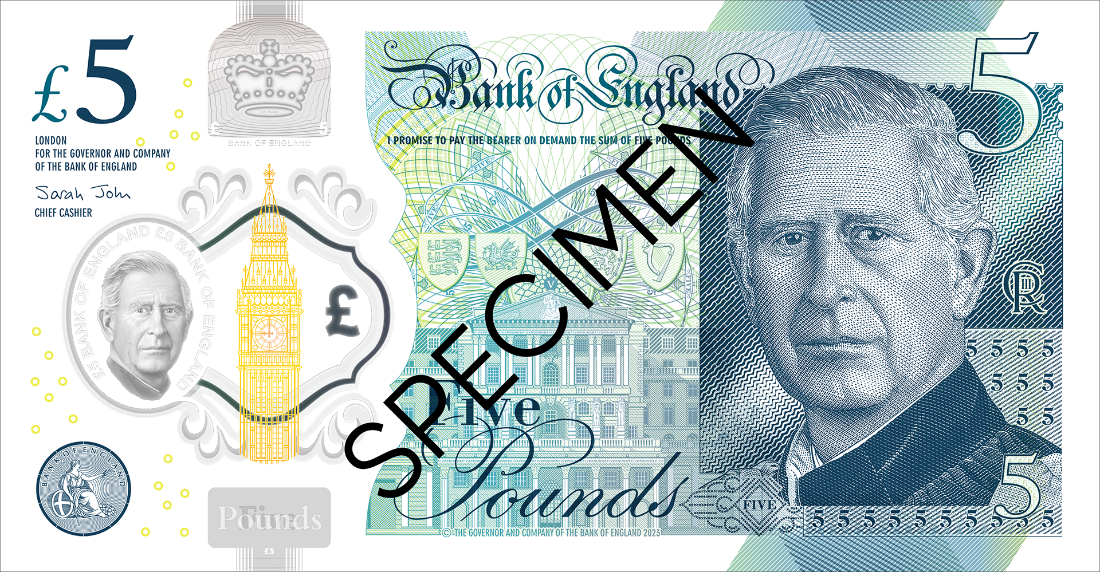
The £5 banknote features Winston Churchill, former British Prime Minister, on the reverse. The polymer version entered circulation on 13 September 2016.
There are currently two versions of this banknote: one featuring Elizabeth II and the other featuring Charles III. Both can be used to pay for purchases.
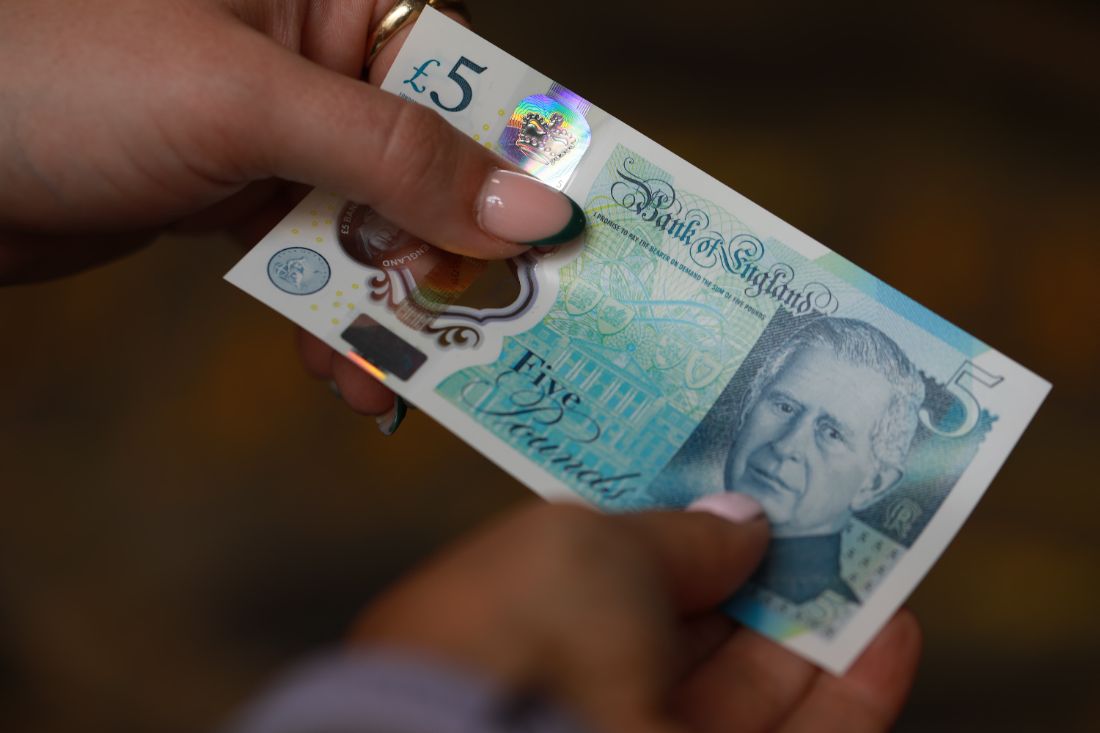
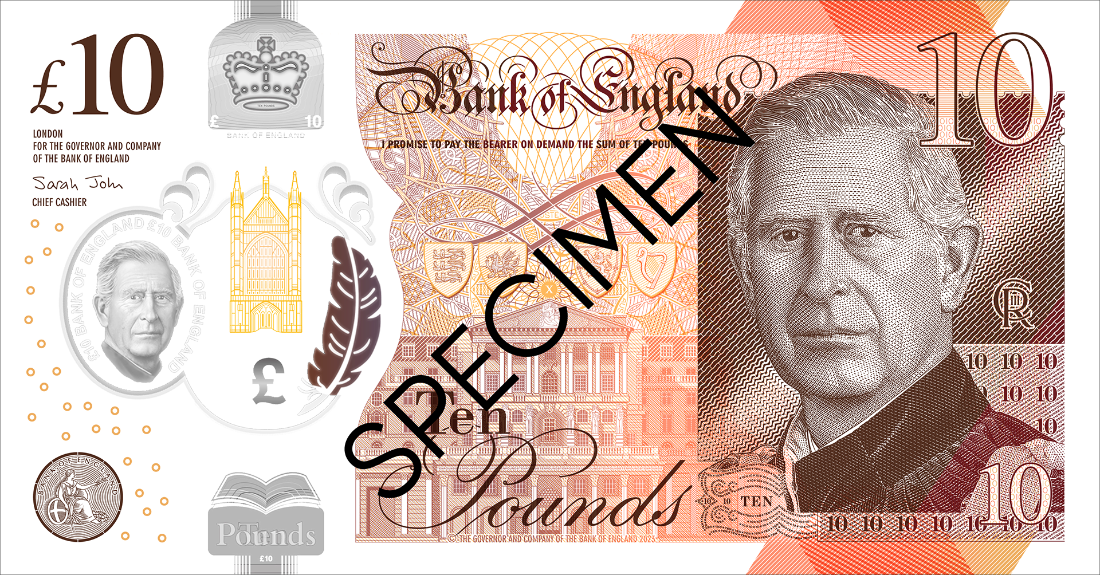
The £10 banknote features British novelist Jane Austen, best known for Pride and Prejudice. The polymer version entered circulation on 14 September 2017.
£10 banknotes featuring Elizabeth II remain valid, as do those featuring Charles III.

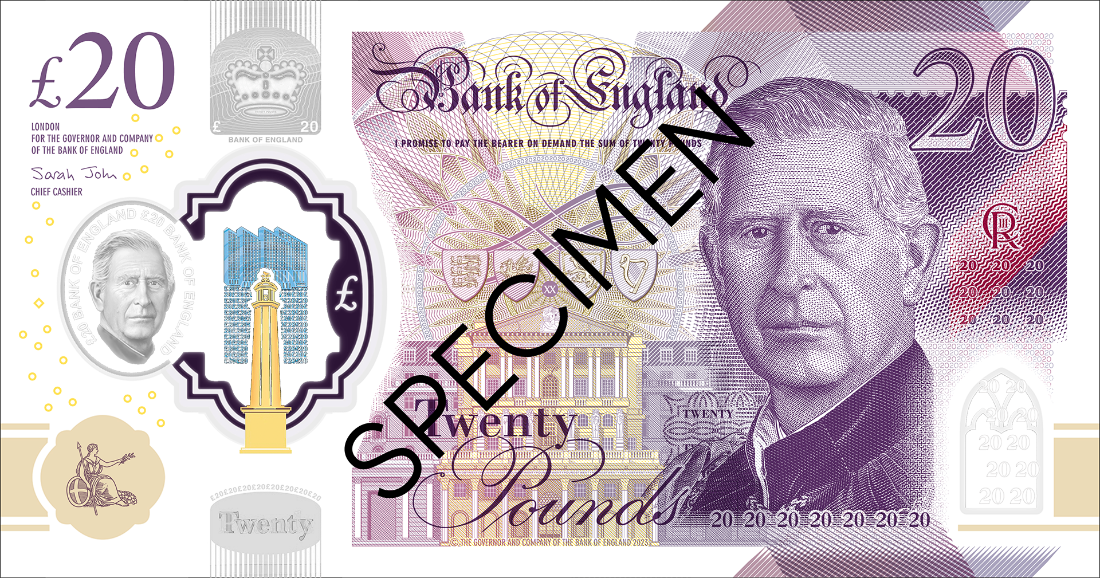
The current £20 banknote features British painter Joseph Mallord William Turner, better known as JMW Turner, on the reverse. The polymer version entered circulation on 20 February 2020.
£20 banknotes featuring Elizabeth II remain valid, as do those featuring Charles III.


The current £50 banknote features Alan Turing, mathematician and pioneer of computing, on the reverse. The polymer version entered circulation on 23 June 2021.
£50 banknotes featuring Elizabeth II remain valid, as do those featuring Charles III.
Official banknote images: Bank of England
The Bank of England is preparing a new series of banknotes dedicated to British wildlife.
On 8 October 2026, it announced the four animals selected for the future banknotes: the puffin, barn owl, buff-tailed bumblebee and European hedgehog.
They will replace historical figures as the main illustrations. The portrait of the monarch will remain on the banknotes.
These new banknotes are not yet in circulation. Their design will take several years, and the Bank of England has not yet announced which animal will appear on each denomination.
The United Kingdom uses eight coin denominations, ranging from one penny to two pounds. They are produced by The Royal Mint.

Image credit: The Royal Mint, 2023
| Value | Name | Visual characteristics |
|---|---|---|
| 1p | One penny | Small, round, copper-coloured coin. |
| 2p | Two pence | Round, copper-coloured coin, larger than the 1p coin. |
| 5p | Five pence | Small, round, silver-coloured coin. |
| 10p | Ten pence | Round, silver-coloured coin, larger than the 5p coin. |
| 20p | Twenty pence | Seven-sided, silver-coloured coin. |
| 50p | Fifty pence | Large, seven-sided, silver-coloured coin. |
| £1 | One pound | Twelve-sided bimetallic coin. |
| £2 | Two pounds | Large, round, bimetallic coin. |
New coins featuring Charles III have gradually been introduced since the change of monarch. They circulate alongside coins featuring Elizabeth II that remain in circulation.
Two coins have their value expressed directly in pounds sterling: £1 and £2.
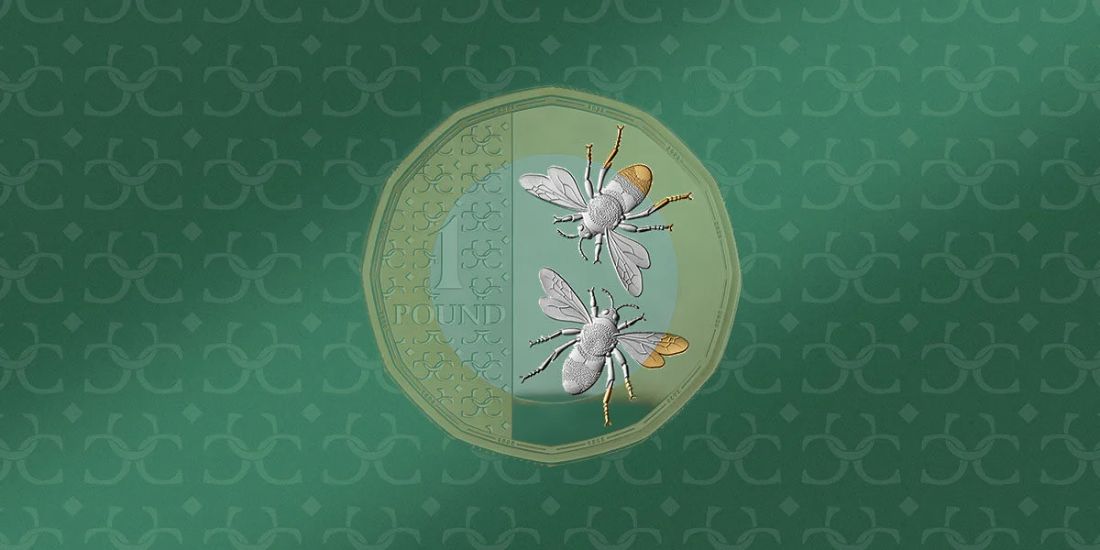
Image credit: The Royal Mint, 2023
The current £1 coin, introduced on 28 March 2017, has twelve sides and a bimetallic structure. It replaced the old round coin, which was particularly vulnerable to counterfeiting.
The design of the £1 coin introduced in 2017 features the four floral emblems of the nations of the United Kingdom on the reverse: the English rose, Welsh leek, Scottish thistle and Northern Irish shamrock. The new Charles III series design features two bees.
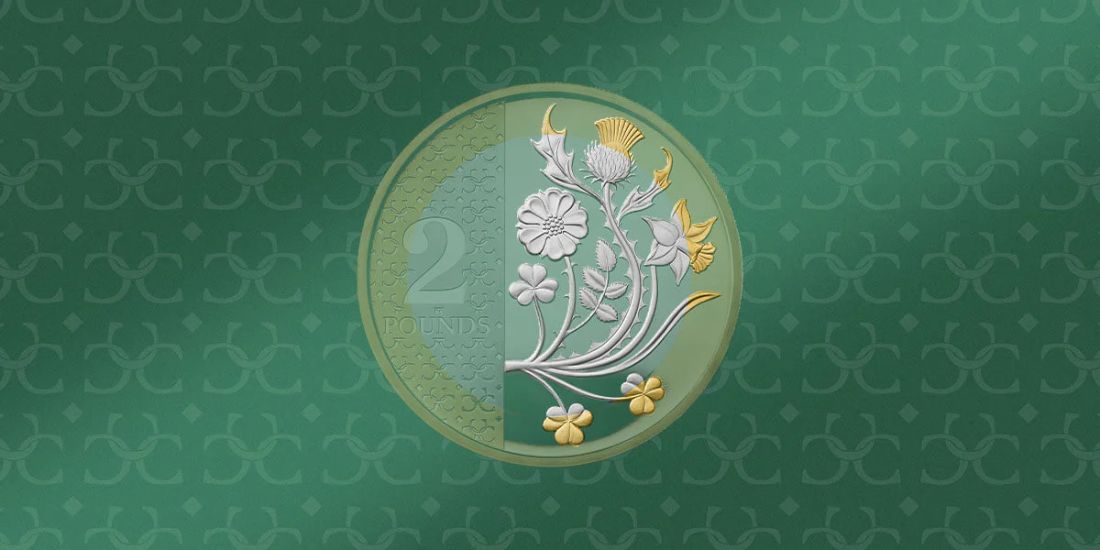
Image credit: The Royal Mint, 2023
The £2 coin is also bimetallic, but it is round and larger than the £1 coin. In the new series, its reverse features a rose for England, a daffodil for Wales, a thistle for Scotland and a shamrock for Northern Ireland.
The other six denominations are expressed in pence:
The 1p and 2p coins are copper-coloured, while coins from 5p to 50p are silver-coloured. The 20p and 50p coins are easily recognised by their seven-sided shape.
To identify a coin's value, look first at the denomination shown on it: several different designs can circulate for the same value.
The Royal Mint unveiled a new series of eight coins featuring Charles III in 2023. Their designs celebrate British wildlife and nature.
The eight new reverse designs feature species and natural symbols from the United Kingdom: a hazel dormouse on 1p, a red squirrel on 2p, oak leaves and acorns on 5p, a capercaillie on 10p, a puffin on 20p, an Atlantic salmon on 50p, two bees on £1 and the flowers of the four nations of the United Kingdom on £2.
These new designs are being introduced gradually. Coins featuring Elizabeth II from series that remain in circulation are still valid, so it is normal to receive coins bearing portraits of different monarchs.
Some old banknotes and coins have been withdrawn from circulation. This does not apply simply because a banknote or coin features Elizabeth II: those belonging to current series remain valid.
The old paper £5, £10, £20 and £50 Bank of England notes have been withdrawn from circulation.
| Old banknote | Withdrawal date |
|---|---|
| Paper £5 note | 5 May 2017 |
| Paper £10 note | 1 March 2018 |
| Paper £20 note | 30 September 2022 |
| Paper £50 note | 30 September 2022 |
These banknotes can no longer be used for everyday purchases, but they retain their face value with the Bank of England.
The Bank of England allows withdrawn banknotes that it has issued to be exchanged with no deadline.
Depending on your circumstances, several options are available:
The procedure and identification requirements depend in particular on the amount being exchanged and your circumstances. The official process is explained on the Bank of England website.
The most common example is the old round £1 coin, which was withdrawn from circulation on 15 October 2017. It was replaced by the twelve-sided bimetallic coin used today.
Unlike withdrawn banknotes, coins that have been withdrawn from circulation are not covered by a general exchange service from The Royal Mint.
Some UK banks may still accept old round £1 coins for deposit into an account. Conditions vary between institutions.
Found some old pounds? First check whether you have paper banknotes, polymer banknotes or coins. The exchange options are different, and a banknote that has been withdrawn from circulation has not necessarily lost its value.
Not all pound sterling banknotes in the United Kingdom are issued by the Bank of England.
In Scotland and Northern Ireland, certain authorised banks issue their own banknotes, featuring different designs from Bank of England notes.
These banknotes are denominated in pounds sterling, but shops are not required to accept them. A retailer in England can therefore refuse a Scottish or Northern Irish banknote.
This is partly explained by the British concept of legal tender. Contrary to a common misconception, legal tender does not mean that a retailer must accept every banknote or coin when you make a purchase.
If you are travelling between different parts of the United Kingdom, Bank of England notes are generally the most convenient for everyday purchases.
The exchange rate between the euro and the pound sterling changes regularly. It indicates how many pounds you receive for one euro, or vice versa.
On a currency converter:
Bear in mind that the rate shown on Google or a currency converter is not necessarily the rate your bank or currency exchange provider will apply. Fees or an exchange-rate margin may be added.
Before exchanging money, check how much you will actually receive after all fees.
In the United Kingdom, you can pay for purchases in cash or by bank card where the retailer accepts it.
Card and contactless payments are common, but having an alternative payment method can still be useful in the event of a technical problem or if a business does not accept your card.
Not necessarily. It depends on the terms of your bank card, the fees charged by your bank and the payment methods accepted during your stay.
If you plan to withdraw cash after arriving in the UK, check any withdrawal and currency conversion fees before you travel.
Some payment terminals offer international visitors the option of paying directly in their home currency rather than in pounds sterling.
advertisement
This immediate conversion, known as Dynamic Currency Conversion (DCC), may use a less favourable exchange rate than your bank.
As a general rule, choosing to pay in pounds sterling (GBP) avoids the conversion offered by the retailer or ATM. However, you should still check the fees charged by your own bank or card provider.
Yes. Current polymer banknotes featuring Elizabeth II remain valid and circulate alongside Charles III banknotes. There is no need to exchange them.
Yes, provided they belong to a series that is still in circulation. A change of monarch does not automatically mean that older coins are withdrawn.
The old round £1 coin, however, was withdrawn from circulation in 2017.
The official currency of the United Kingdom is the pound sterling. Some businesses may accept euros, but they are not required to do so and the exchange rate offered may be unfavourable.
For everyday purchases, you should therefore plan to pay in pounds sterling.
A sovereign is a British gold coin that was historically used as currency and is now primarily sought after for investment or collecting.
It is not one of the eight coin denominations used for everyday purchases in the United Kingdom.
Yes. Some old, rare or collectible coins may have a numismatic value higher than the amount shown on the coin.
Their value depends on factors including rarity, condition and demand. An old coin is not necessarily rare or valuable.
The pound sterling (£, GBP) is the official currency of the United Kingdom. It is divided into 100 pence and has four banknote denominations (£5, £10, £20 and £50) and eight coin denominations, ranging from 1p to £2.
Current banknotes are made from polymer. Those featuring Elizabeth II remain valid and circulate alongside Charles III banknotes, which were introduced in 2024. Coins featuring both monarchs also remain in circulation.
Old paper banknotes are no longer accepted in shops but can be exchanged with the Bank of England. The old round £1 coin, replaced in 2017, can no longer be used for everyday payments.
If you are preparing for a trip to the UK, the main things to remember are the principal banknote and coin denominations, any fees charged by your bank or card provider, and to choose pounds sterling when paying.
Planning your trip? These are the tours and tickets travellers book most.