
How to Visit Buckingham Palace in London in 2025?
- The history of Buckingham Palace
- The current role of Buckingham Palace and its residents
- Visiting Buckingham Palace
- Changing the Guard at Buckingham Palace
- Buckingham Palace opening hours
- Buckingham Palace ticket prices
- How to get to Buckingham Palace
- What to see near Buckingham Palace
- Where to stay near Buckingham Palace
- FAQ: Frequently Asked Questions about Buckingham Palace
Buckingham Palace is the official residence of King Charles III in London and one of the most famous landmarks in the United Kingdom. Located in the heart of the British capital, near St James's Park and the Palace of Westminster, it attracts millions of visitors every year who come to discover the world of the monarchy. A symbol of power and prestige, Buckingham Palace fascinates with its architecture, history, and role in the political and ceremonial life of the country. Between the splendid State Rooms, the magnificent gardens and the iconic Changing of the Guard, visiting Buckingham Palace is a must during any stay in London.
Book your Buckingham Palace tickets online today and enjoy a unique experience in the heart of the British monarchy:

advertisement
The history of Buckingham Palace
Buckingham Palace has a history spanning more than 300 years. In 1703, it was built for John Sheffield, Duke of Buckingham and Normanby, as an elegant country house known as Buckingham House. At that time, its style reflected the restrained architecture of the 18th century, far from the monumental palace we know today.
In 1762, King George III purchased the residence to make it the private home of his wife, Queen Charlotte. It then became known as the Queen's House, where several royal children were born.
At the beginning of the 19th century, King George IV decided to transform the house into a true royal palace. Architect John Nash was commissioned to design a majestic residence. He added three wings around a central courtyard and created lavish neoclassical interiors.
His successor, William IV, inherited the building but preferred to reside elsewhere. It was finally in 1837, when Queen Victoria ascended the throne, that Buckingham Palace officially became the principal residence of the British monarchy.
When she arrived, Queen Victoria found the palace uncomfortable: poor heating, inadequate ventilation, and a lack of modern conveniences. Extensive works were needed to make it suitable for a royal court.
Over the following decades, the palace was further expanded. Architect Edward Blore completed the structure, and in 1913, the façade facing The Mall was redesigned by Sir Aston Webb in the iconic white neoclassical style admired today.
During the Second World War, the palace suffered several bombings. Nevertheless, the royal family decided to remain in London, a choice that strengthened their bond with the British people and made the palace a symbol of national resilience.
Today, Buckingham Palace remains at the heart of the United Kingdom's history and political life, hosting major ceremonies, state visits and milestone events of the monarchy.
The current role of Buckingham Palace and its residents
Buckingham Palace is not only a historic monument, but also the official residence of King Charles III in London. Since 2022, the King and Queen Camilla have occupied the private apartments located in the north wing of the palace.
Above all, the palace is a place of work and representation. Every week, the King meets the Prime Minister, receives foreign dignitaries and holds official audiences. It is also within its walls that state banquets, investitures, and grand royal receptions are held.
Each year, nearly 50,000 guests attend receptions, garden parties and ceremonies at Buckingham Palace.
The palace also employs over 800 staff members, ranging from butlers and gardeners to secretaries, chefs, security officers and art curators. Like a small town, it operates as a well-organised machine serving the monarchy.
The State Rooms, located in the west wing, are used during official ceremonies. They are decorated with tapestries, chandeliers and artworks from the Royal Collection, one of the most prestigious art collections in the world.
The Royal Flag: symbol of the sovereign's presence
One detail always catches visitors' attention: the flag flying above the palace. This symbol follows a precise protocol:
- The Union Jack: indicates that the King is not present in the palace.
- The Royal Standard: flies when the sovereign is at Buckingham Palace. This richly decorated flag represents the royal coat of arms with the lions of England, the lion of Scotland and the harp of Ireland.
In September 2022, upon the death of Queen Elizabeth II, the flag flown at half-mast above the palace became one of the most powerful symbols of national mourning.
Beyond its residential function, Buckingham Palace remains an emblem of the British monarchy. Crowds gather here for jubilees, royal weddings, and state events, making the palace a place where the history of the United Kingdom is constantly being written.
Visiting Buckingham Palace
Each summer, when the sovereign stays at Balmoral Castle in Scotland, Buckingham Palace opens its doors to visitors. It is a unique opportunity to explore one of London's most iconic landmarks and admire its lavish interiors. With its richly decorated State Rooms and vast gardens, the palace attracts hundreds of thousands of curious visitors from around the world every year.
Multilingual audio guides (French, Spanish, German, Italian, Japanese, etc.) are included free of charge with the ticket, ensuring an immersive experience for all visitors.
The State Rooms: the official apartments
Out of the palace's 600+ rooms, 19 State Rooms are open to the public. These grand spaces form the heart of the palace's ceremonial life:
- The Grand Staircase: a monumental staircase designed by John Nash, adorned with official portraits of the royal family.
- The State Dining Room: the official dining room used for state banquets, decorated with Sèvres porcelain.
- The Picture Gallery: a 50-metre-long gallery exhibiting masterpieces by Rembrandt, Rubens, Van Dyck and Canaletto.
- The Green Drawing Room: a reception room where official guests wait before being presented to the sovereign.
- The Throne Room: used for investitures, official photographs and providing access to the palace's famous balcony.
The Royal Gardens
At the back of the palace stretches an immense private garden of 160 hectares, a true oasis of greenery in the heart of London. This unique garden features:
- A picturesque lake inhabited by swans and rare birds.
- Over 350 species of wildflowers, carefully maintained flowerbeds and century-old trees.
- A spectacular view of the palace's west façade.
The Garden Café, located in the inner courtyard, offers a pleasant break with tea, pastries and refreshments.
Allow at least 2 hours to visit the State Rooms, and double that if you also want to stroll through the gardens and enjoy the surroundings.
Security checks at the entrance are similar to those at an airport. Photography and filming are not allowed inside, but they are permitted in the gardens.
Temporary exhibitions
Each year, a temporary exhibition at Buckingham Palace enhances the visit to the State Rooms. These exhibitions highlight a particular aspect of the monarchy and sometimes allow access to areas usually closed to the public.
- 2024 - Opening of the East Wing: for the first time, the east wing of the palace was opened to visitors after several years of restoration. Guests discovered the palace's famous balcony, the Yellow Drawing Room, and newly restored Chinese decorative pieces.
- 2025 - The King's Tour Artists: an exhibition showcasing more than 70 works from the private collection of King Charles III, many of which were displayed for the first time. A unique insight into the king's artistic taste and the richness of the Royal Collection.
These recent exhibitions reflect the intention to make Buckingham Palace more accessible to the public while enriching the visitor experience by showcasing its historical and artistic heritage.
Changing the Guard at Buckingham Palace
Among the most iconic traditions of the United Kingdom, the Changing of the Guard is a central attraction. This military ceremony draws millions of visitors every year, who come to admire the discipline of the royal guards dressed in their red uniforms and bearskin hats.
The ceremony takes place in front of the main entrance of Buckingham Palace. The guards on duty hand over to the new regiment, accompanied by a military band that plays both classical marches and, occasionally, contemporary pieces to surprise the audience.
The tradition of the Changing of the Guard dates back more than 1,000 years, perpetuating the image of the British monarchy as both historic and alive.
The ceremony usually takes place every Monday, Wednesday, Friday and Sunday at 11:30 am. However, it can be cancelled in case of rain or exceptional official events. Before planning your visit, it is recommended to check the schedule published by the British Army.
Tips for watching the Changing of the Guard
- Arrive 30 to 45 minutes early to secure a good spot, especially during peak season.
- The best views are from the palace gates, along The Mall, and around the Victoria Memorial.
- Be prepared for large crowds: the Changing of the Guard is one of London's most popular free events.
- Check the weather forecast: bring an umbrella or raincoat, as the ceremony takes place outdoors.
Buckingham Palace opening hours
Buckingham Palace is not open to visitors all year round. Public access is mainly available during the summer months, from July to September or October, when the monarch resides at Balmoral Castle in Scotland.
Entry is only possible at the time indicated on your ticket, in order to limit the number of visitors inside the State Rooms and ensure a comfortable experience.
Every spring, the precise summer opening dates are published on the official Royal Collection Trust website.
Unlike Kensington Palace, which is open all year round, Buckingham Palace is only accessible during its summer opening season.
Buckingham Palace ticket prices
You can easily buy your Buckingham Palace tickets in London online, with options available for adults, students, families and children:
Ticket prices vary depending on age and visitor category:
- Adult: £26.50
- Senior (60+) and student: £24
- Child (under 17) and disabled visitor: £14.50
- Child under 5: free
- Family (2 adults + 3 children): £67.50
Tickets can be purchased:
- From partner resellers, who sometimes offer discounts or combined packages.
- Directly on the official Royal Collection Trust website.
To make the most of your visit, it is recommended to book your tickets several weeks in advance. Morning and early afternoon time slots sell out quickly, especially in July and August.
How to get to Buckingham Palace
Located in the heart of London, Buckingham Palace sits between the royal parks St James's Park and Green Park, at the address SW1A 1AA. It is easily accessible by public transport.
Arrive at least 15 minutes before your scheduled visit. Arriving early helps you pass through security checks (similar to those at an airport) smoothly and enjoy your visit without stress.
By underground
- Green Park: Jubilee, Piccadilly and Victoria lines
- Hyde Park Corner: Piccadilly line
- Victoria Station: Circle, District and Victoria lines
By train
The nearest railway station is Victoria Station, about a 10-minute walk from the palace. From there, you can directly reach South London and several major UK destinations.
By bus
Several bus routes serve Buckingham Palace. The most convenient are:
- Routes 11, 211, C1 and C10 - stop on Buckingham Palace Road.
On foot
The palace is within walking distance of landmarks such as Westminster Abbey, Big Ben, Piccadilly Circus and Trafalgar Square. A stroll through St James's Park or Green Park offers a pleasant way to reach it.
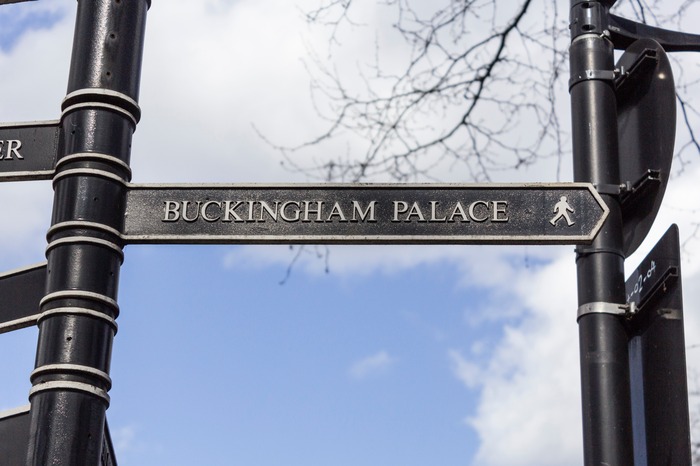
Directional sign pointing towards Buckingham Palace, one of London's most iconic landmarks
By car
Driving is not recommended as parking is limited and very expensive in central London. It is best to use public transport instead.
What to see near Buckingham Palace
A visit to Buckingham Palace can easily be part of a day exploring central London. Many of the city's major landmarks are located just a few minutes' walk away.
Iconic landmarks
- Westminster Abbey: site of royal coronations and weddings, and a UNESCO World Heritage Site.
- Palace of Westminster & Big Ben: seat of the UK Parliament and one of the most famous symbols of London.
- Queen Victoria Memorial: the imposing white marble statue located directly in front of the palace.
Royal parks
- St James's Park: ideal for a stroll with stunning views of the palace and its gardens.
- Green Park: a tranquil green space perfect for relaxing after your visit.
- Hyde Park: one of London's largest parks, just a few minutes away by underground.
Lively districts and squares
- Piccadilly Circus: famous for its giant neon screens, theatres and bustling atmosphere.
- Trafalgar Square: one of London's best-known squares, home to the National Gallery and lively public events.
- Victoria: a vibrant area with plenty of restaurants, pubs and West End musicals.
advertisement
If you want to continue exploring the British monarchy, consider visiting Kensington Palace, the historic residence of Princess Diana and today the home of the Prince and Princess of Wales. Unlike Buckingham Palace, it is open to the public all year round.
Where to stay near Buckingham Palace
Staying close to Buckingham Palace makes it easy to visit London's main attractions while enjoying a prestigious and central location.
Top hotels near the palace
Among the hotels around Buckingham Palace, some stand out for their comfort and prime location:
- Rubens at the Palace (5 stars): elegant address facing the Royal Mews with polished service and classic British charm.
- The Goring (5 stars): iconic boutique luxury, famous for its refined interiors and discreet hospitality.
- St. James' Court, A Taj Hotel, London (4 stars): Victorian elegance with modern comforts, five minutes' walk from the palace.
- Premier Inn London Victoria (3 stars): budget-friendly and family-oriented, a short stroll from Victoria Station.
Recommended areas
If you can't find immediate availability right next to the palace, the following districts are excellent alternatives:
- Victoria: great transport hub with plentiful restaurants and theatres, perfect for quick citywide connections.
- St James's: upscale and quiet, moments from St James's Park and the palace.
- Westminster: close to Big Ben, Westminster Abbey and the Houses of Parliament.
Summer and royal event dates sell out fast. Compare deals and secure flexible rates with our partner Booking.com.
FAQ: Frequently Asked Questions about Buckingham Palace
- When can you visit Buckingham Palace? The State Rooms are open to the public mainly in summer, usually from July to September/October. Exact dates are announced each year in spring.
- How long does a visit to Buckingham Palace take? Allow around 2 hours for the State Rooms, and up to 4 hours if you also visit the gardens.
- Can you see the Changing of the Guard at Buckingham Palace? Yes, the Changing of the Guard takes place at 11:30 a.m. on Mondays, Wednesdays, Fridays, and Sundays outside the palace gates.
- How much are tickets to Buckingham Palace? Adult tickets cost around £26.50. Reduced prices are available for seniors, students, and children. Under-5s enter free.
- How to book tickets for Buckingham Palace? You can purchase your tickets online via our partners or directly on the official Royal Collection Trust website. It is strongly recommended to book in advance, especially during the summer season.
- Can you take photos inside Buckingham Palace? No, photography and filming are not permitted inside the State Rooms, but both are allowed in the gardens.
- Who lives in Buckingham Palace? It is the official London residence of King Charles III and some members of the royal family. A number of staff also live and work there.
- What's the nearest tube station to Buckingham Palace? The closest underground stations are Green Park, Victoria, and Hyde Park Corner.
- Can you buy tickets on the day? It is strongly recommended to book in advance as tickets often sell out, especially in July and August.
- Is Buckingham Palace open all year round? No, unlike Kensington Palace, Buckingham Palace is only open during its summer season.
- What else can you see near Buckingham Palace? Nearby attractions include Westminster Abbey, the Palace of Westminster, St James's Park, Green Park, and Piccadilly Circus.
- Is Buckingham Palace accessible for visitors with reduced mobility? Yes, specific facilities are in place to ensure accessibility for all visitors.
A visit to Buckingham Palace is one of the highlights of any trip to London. As the official residence of King Charles III and the royal family, the palace embodies both the history and the living traditions of the United Kingdom. Between the Changing of the Guard, the exploration of the State Rooms, and a walk through the Royal Gardens, every visitor is immersed in the very heart of Britain's heritage. Be sure to book your Buckingham Palace tickets for 2025 in advance to guarantee entry and make the most of this unforgettable London attraction.