On the 51st anniversary of the start of the Mangrove 9 trial, we unveil a Nubian Jak Blue Plaque in honour of the Black British Civil Rights legend Dr Altheia Jones-Lecointe.
Previous Black History Walks plaques honouring UK Civil Rights activists include Dr Harold Moody, Dr Cecil Belfield Clarke, Frank Chrichlow and Darcus Howe. Dr Jones-Lecointe was recently portrayed in the BBC drama 'Mangrove' directed by Steve McQueen. Her character was played by Letitia Wright who was also the star of the Marvel Superhero movie 'Black Panther: Wakanda Forever'
Exact address and agenda will be announced closer to the time
Why a Blue Plaque to Dr Altheia Jones Le Cointe ?
This article by Phd student Jada Gannaway of Michigan State University gives some background.
On Sunday, August 9, 1970, British Black Panther activists and sympathizers flooded London’s Notting Hill neighborhood in response to rampant racial violence and police brutality. Hundreds of aggrieved Black Britons, many of whom were wearing black berets, dark glasses, leather jackets and black bell-bottoms, took to the streets, chanting, holding placards and banners that read “POWER TO THE PEOPLE,” “STOP POLICE BRUTALITY,” and “SLAVERY IS STILL ALIVE.” Among the fist-waving and Afro-wearing activists was one of the Black Panther Movement’s most prominent leaders: Trinidadian-born Altheia Jones-Lecointe.
Two hours into the demonstration, Jones-Lecointe and the crowd of discontented Black Brits were in a brawl with the Notting Hill Police. She along with eight other protestors (Darcus Howe, Frank Crichlow, Barbara Beese, Anthony Carlisle Innis, Rothwell Kentish, Rhodan Gordon, Rupert Glasgow Boyce, and Godfrey Millett), were recognized as members of the “militant” Black Power organization: The Black Panther Movement (BPM). They were each charged with causing an affray, assaulting an officer, and being in possession of an “offensive weapon.” Their case was sent to the Old Bailey Central Criminal Court. The trial of the Mangrove Nine, as the press referred to them, received national attention. Representing herself, while eight weeks pregnant, Jones-Lecointe highlighted the racial undertones that permeated throughout Britain’s police force. Her participation in mobilizing a cadre of first- and second-generation Black Britons and substantiating ideas of belonging in London is instructive of her political engagement in radical politics.
The groundbreaking court case of the Mangrove Nine, in addition to the political environment of the 1960s and 1970s changed the life of Jones-Lecointe, a revolutionary figure who found herself on the front pages of news reports and various media outlets—yet today her story remains largely untold. Examining Altheia Jones-Lecointe’s activism in London, specifically her leadership role within the BPM, offers us a window into the political contributions of lesser-known Afro-Caribbean women activists in Black Briton’s freedom struggle. Unlike her seasoned 1960s transnational activist and co-defendant, Darcus Howe, whose political contributions have been widely documented, Jones-Lecointe’s political influence on the Black Liberation Movement in both Trinidad and London remains obscured. More attention needs to be given to the lives and experiences of Black women activists who led and participated in the global Black Power Movement to advance our understanding. I argue, by interrogating the multilayered experiences of Black women activists, like Jones-Lecointe, we can see the globalized themes of the Black freedom tradition of racial pride, self-determination, anti-colonialism, and self-defense among others.
The eldest daughter of eight children, Altheia Jones participated in reform politics via her family’s political work in Eric Williams’s People’s National Movement (PNM) in Trinidad in the early 1960s. Engulfed in grassroots organizing since the age of twelve, Jones-Lecointe led Britain’s Black Panther Movement (BBPM) in London with “rigid discipline” from 1969 to 1973. Under Jones-Lecointe, people couldn’t just walk up and join the party but had to undergo a series of ideological trainings and uphold the Movement’s strict moral code. Additionally, the BPM members were skeptical of “outsiders,” and they kept few written records due to countless threats of state violence and surveillance. Nonetheless, Jones-Lecointe served a crucial role in mobilizing Britons of African, Afro-Caribbean, and South Asian descent against police brutality, discriminatory immigration legislations, economic oppression, just to name a few. One of Briton’s BPM political organizing sites was the Mangrove Restaurant.
In 1969, Trinidadian-native Frank Crichlow opened the Caribbean eatery. Located in London’s Notting Hill, an area known for Black political activism in the late 1960s, racially and ethnically diverse bodies dined on “soul food”: porterhouse steaks, rice and beans, fried plantains, and a host of other mouth-watering West Indian cuisines. BPM members and their affiliates frequented the political and cultural haven that was the Mangrove to discuss their grievances and resentments towards the mounting oppressions they faced. The Mangrove served as a Black cultural hub where Black political actors could go to enjoy a traditional Caribbean cuisine, see advertisements of African Art, and to discuss the global struggle against colonialism. The BPM would host weekly meetings where they read books on Marxist-Leninist theory, the histories of the Caribbean, slavery, and the British Empire, among others. Despite not being a hotbed of illegal activity, Police Constables, like Frank Pulley, incorrectly described the Black vibrant Caribbean restaurant as a “den of iniquity” frequented by “pimps, prostitutes and criminals. Following a series of drug raids conducted by the Notting Hill police in June 1969 and May 1970, members of the BPM and their affiliates planned to protest the Mangrove raids.
On Sunday, August 9, 1970, at approximately 3:00 p.m. British Black Panther members poured into the streets of Notting Hill, heading towards the Notting Dale Police station. Roughly two-hundred police officers were deployed by J. H Gerrard, the Deputy Assistant Commissioner. Officers were instructed to maintain order of the procession. Under the guise of “protecting and serving” the metropole, officers casted political figures like Jones-Lecointe, Darcus Howe, and Barbara Beese as political instigators, drug users, and criminals. As the demonstrators peacefully made their way to Ladbroke Grove police station, they continued to call out Black Power chants of “Black Power! —People’s Power!” Two hours into the protest, a standoff between the police and the protestors erupted on the northern end of Portnall Road. Activists armed themselves with makeshift weapons such as bottles, bricks, and wooden sticks. They fought endlessly to protect themselves. Two to three officers beat and dragged men and women into their vehicles as they struggled to arrest the demonstrators and maintain control of the procession. What began as a peaceful protest ended with seventeen policemen injured and the arrest of nineteen people, including Althea Jones-Lecointe.
The Notting Hill demonstration garnered national attention. News reports from the Daily Mail, The Times, The Evening Standard, among others flooded the media with images and writings regarding the potential risks of Black violence following the march. Cultural and political productions of Black Power, African art, posters that called for the end of police brutality (including slogans like “Black is beautiful”) were weaponized in the media to support the mythology of Black criminality. Nevertheless, the demonstration highlighted the escalating tensions between discontented Black Britons and the state’s authority.
On October 5, 1971, the Mangrove Nine trial began. The director of public prosecutions charged the defendants with 31 charges from the Mangrove Demonstration. Deciding to represent themselves, Howe, Jones-Lecointe and later Rhodan Gordon used their experiences of being Black in the metropole to underscore Britain’s explicit unwillingness to protect Blacks from institutional racism that permeated throughout British society. They addressed issues of police brutality, police harassment, and neocolonialism. Lasting ten weeks, Judge Edward Clarke asserted that it was evident that pure racial hatred existed. Clarke’s remarks caused an uproar amongst the metropolitan police as it was the first time in Britain’s history that a British official acknowledged state racism. On the 15th of December 1971, the jury reached a verdict, finding the defendants not guilty. Representing herself Altheia Jones-Lecointe highlighted the institutional racism that plagued British society; revealing how both the metropolitan police and the British government had failed politically and economically to support Black Britons who were deserving of state rights and protections.
After the trial, Jones-Lecointe continued to lead the BPM until its demise in 1973. Though she led a formidable male-dominated movement that amassed a huge following in neighboring cities, organized over 140 demonstrations, and 77 cultural events, Jones-Lecointe’s legacy remains a mystery to many. Due to intense political suppression, police surveillance, and state violence Jones-Lecointe has rarely agreed to partake in oral interviews that attempt to recognize her political activism. The absence of her voice from the historical record, and its impact on scholarship, reveals the lasting influence of the British government on our historical narratives. Nevertheless, as historian Ashley Farmer has noted, the lack of sources is no longer an acceptable justification to marginalize Black women—or race and gender analyses—in history. By adjusting our methodologies—reading against the biases, power imbalances, and violence of the archive— Black women activists can be rescued from obscurity in the archive and new histories can be generated. https://www.nacbs.org/post/althea-jones-lecointe
****************************************************************************************************
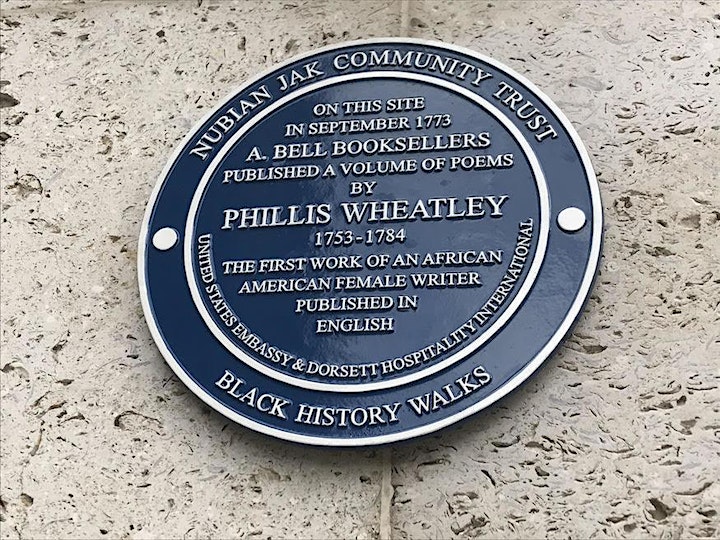
This plaque is produced by Nubian Jak and sponsored by Black History Walks. It will be unveiled near Finsbury Park . Exact address will be announced two weeks before the event.Full details and agenda sent to those who have registered
Dr Altheia Jones Lecointe is highlighted in our latest book 'Black History Walks in London Vol 1' (see image below) available on Amazon and Audible. The Notting Hill Black Panthers and the Mangrove 9 also feature in our Pearson GCSE History exam text book which is part based on our Notting Hill walk
Correcting the lack of historical blue plaques to Black people
Blue Plaques are associated with English Heritage but according to their own research only 4% of their 900 London plaques represent Black and Asian people, the percentage of Black people in London is 40% https://www.english-heritage.org.uk/about-us/search-news/diversity-blue-plaques/ In 2016 they set up an initiative to find evidence for more diverse plaques. B.A.S.A, the Black and Asian Studies Association has been submitting names and lobbying for more Black people on plaques since the 1990s.
Out of 900 English Heritage plaques in London, only 18 are about Black people or just 2%. Their blue plaque scheme goes back to 1866. English Heritage is a body that was set up in 1983. Their budget is around £180 million.
The Nubian Jak charity has unveiled 84 plaques and two statues honouring African/Caribbean people. They were established in 2006 and do not have even 1% of the English Heritage budget.
xxxxxxxxxxxxxxxxxxxxxxxxxxxxxxxxxxxxxxxxxxxxxxxxxxxxxxxxxxxxxxxx


Calitatea conținutului nostru este esențială!
N'hésitez pas à nous signaler toute erreur ou information complémentaire sur cet évènement.