London South Bank University
Elephant and Castle, London, SE1Wednesday 12 April de 10:00 à 13:00
sur inscription
Latest update 11.00am 11th April 2023
10.30am DJ and musical interlude
The plaque will unveiled outside 112 Newington Causeway, London Se1 6NJ which is on the corner of the Causeway and Southwark Bridge Road
The event starts at 11am and the agenda is as follows:
Host Jak Buela Nubian Jak Community Trust
- L’Myah Sherae, Founder The All-Party Parliamentary Group for Race Equality in Education
- Latifa Patel, British Medical Association Representative Body Chair
- Dr Collin Higgins St Catharine’s College, Cambridge University
- Kamran Abbasi, Chief of the British Medical Journal
- Stephen Bourne, author and historian ( Under Fire - Black Britain in Wartime 1939-45)
- Marty Sandiego, Black Travel Alliance
- Rachel Picton, Dean of Allied and Community Health South Bank University
- Tony Warner, Black History Walks, Plaque funder
- Bishop of Croydon, Right Reverend Dr Rosemarie Mallett
- Barbados High Commissioner His Excellency Milton Inniss
There will be a reception from 12-1p pm at the London South Bank University Hub, Keyworth street
1-2pm lecture on Dr Cecil Belfield Clarke inside the Westminster theatre, at the Hub
7 similar events listed here https://myemail.constantcontact.com/Fighting--to-get-our-history-on-the-streets.html?soid=1102546528894&aid=BwV15uGDRL8
xxxxxxxxxxxxxxxxxxxxxxxxxxxxxxxxxxxxxxxxxxxxxxxxxxxxxxxxxxxxxxxx
11am short speeches and unveiling :British Medical Association,British Medical Journal, London South Bank University,Barbados government,Stephen Bourne, S.I Martin, Dr Rosemarie Bishop.
12pm reception
1pm lecture on Dr Cecil Belfield Clarke
Full details and address sent to those who have registered
Dr Clarke is highlighted in our latest book 'Black History Walks in London Vol 1' (see image below) available on Amazon and Audible.
Why a Blue Plaque to Dr Cecil Belfield Clarke ?
He was a pupil at Combermere School in Barbados. He won the island's scholarship in Natural Science and secured a place at St Catharine’s, Cambridge University in 1914, which meant he travelled across the Atlantic during the First World War.
After completing his training at University College Hospital in London, Clarke opened a medical practice near Elephant and Castle in London, where he worked for nearly 50 years. He had a distinguished record of public service to the medical profession in the UK, the West Indies and Ghana. By 1936, he was a District Medical Officer and was reported to be the only Black man to hold this post in the whole of the London County Council at the time. He also served for many years on the Colonial Advisory Medical Committee under the Secretary of State for the Colonies.
Clarke was a leading figure in race relations in London and internationally from the early 1930s onwards. He was a founding member and benefactor of the League of Coloured Peoples (see our blue plaque to Harold Moody below) and an active supporter of the West African Students Union (see Professor Hakim Adi) since its inception. He was also elected First Chairman of the House Committee of Aggrey House, a hostel for African students and students of African descent, and was a Governor of the new West Indian Students Centre at Earls Court, London. He was involved in planning the Conference on the African Peoples, Democracy and World Peace held in London in July 1939.
According to Clarke’s contemporaries, he was known to be gay – at least among his immediate Black community. From the 1930s, he lived with Edward G. (‘Pat’) Walter, who accompanied him on various overseas trips in the 1950s–60s. Correspondence with their peers includes greetings to and from Clarke and Walter as a couple.
At his request in 1952, a prize was established by the College for outstanding performance in Biological Natural Sciences Tripos examinations. The Belfield Clarke Prize is still given to this day.
He was a strong supporter of St Catherine's College throughout his life, culminating in his unanimous election as President of the St Catharine’s College Society (1965–66).
By the middle of the 20th century, Clarke was well-known to many international visitors to London, who benefited from his medical talent and hospitality. He hosted W. E. B. Du Bois, when the sociologist and co-founder of the National Association for the Advancement of Colored People (NAACP) visited London in 1945, and the pair stayed in regular contact into the 1960s. Clarke treated the daughter of Nobel Prize winner Ralph Bunche, who was referred to him by the Kenyan leader Jomo Kenyatta. The Pan-Africanist George Padmore underwent throat surgery, either by Clarke or a trustworthy colleague, and his recovery was overseen by Clarke.
In the 1950s, Clarke was elected to the Council of the British Medical Association as representative for the West Indies, and appointed Medical Adviser to the newly-independent government of Ghana with the further official title of Senior Medical Officer. https://www.caths.cam.ac.uk/about-us/history/black-history/c-b-clarke
****************************************************************************************************
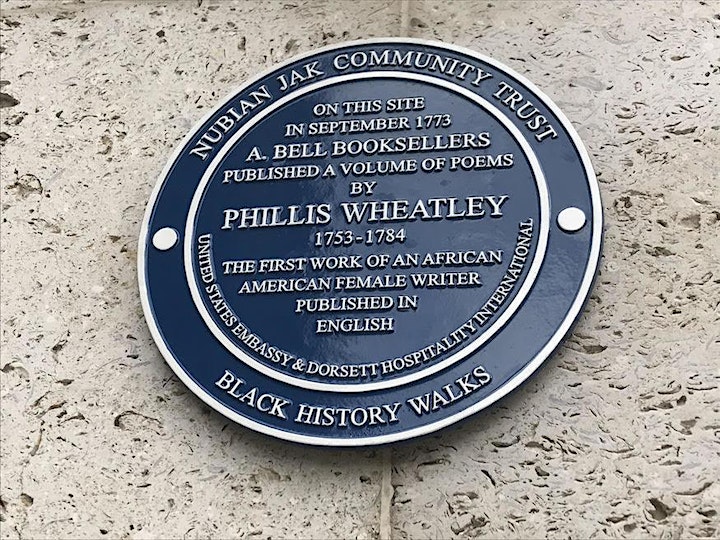
This plaque is produced by Nubian Jak and sponsored by Black History Walks. It will be unveiled near Elephant and Castle. Exact address will be announced two weeks before the event.
This event will be physical but will also be delivered via Zoom. Please check your JUNK MAIL for the confirmation
Correcting the lack of historical blue plaques to Black people
Blue Plaques are associated with English Heritage but according to their own research only 4% of their 900 London plaques represent Black and Asian people, the percentage of Black people in London is 40% https://www.english-heritage.org.uk/about-us/search-news/diversity-blue-plaques/ In 2016 they set up an initiative to find evidence for more diverse plaques. B.A.S.A, the Black and Asian Studies Association has been submitting names and lobbying for more Black people on plaques since the 1990s.
Out of 900 English Heritage plaques in London, only 18 are about Black people or just 2%. Their blue plaque scheme goes back to 1866. English Heritage is a body that was set up in 1983. Their budget is around £180 million.
The Nubian Jak charity has unveiled 77 plaques and two statues honouring African/Caribbean people. They were established in 2006 and do not have even 1% of the English Heritage budget.




La qualità del nostro contenuto è fondamentale!
N'hésitez pas à nous signaler toute erreur ou information complémentaire sur cet évènement.